

Insurance Companies That Cover LASIK Eye Surgery

Coverage & Cost Options – Discover how LASIK insurance works, which companies offer discounts, and how to use FSAs and HSAs for real savings.
The Big Picture
Is LASIK Covered by Insurance?
LASIK eye surgery is a popular procedure for correcting vision – and many people consider it to reduce dependence on glasses or contact lenses. But cost is a significant concern, and one of the most common questions is: is LASIK covered by insurance?
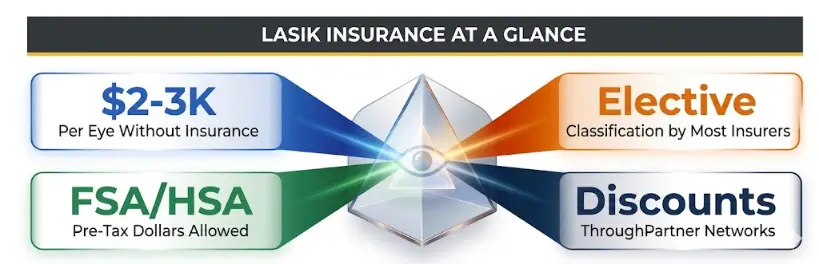
The answer isn’t straightforward. Most insurance plans classify LASIK as an elective procedure, which means many insurance companies don’t cover it directly. However, some do offer discounts or partial coverage, and tools like FSAs, HSAs, and employer benefits can make LASIK significantly more affordable. This guide explains exactly how to navigate them.
The cost of LASIK without insurance typically ranges from $2,000 to $3,000 per eye, though this varies based on technology and surgeon experience. Financing options are almost always available to help manage costs.
Why So Many Patients Choose LASIK
Understanding LASIK Eye Surgery and Its Popularity
LASIK stands for Laser-Assisted In Situ Keratomileusis. It reshapes the cornea to improve vision and is a common procedure for those with nearsightedness, farsightedness, or astigmatism. Many patients achieve 20/20 vision or better after the procedure, and satisfaction rates are consistently high.
The popularity of LASIK continues to grow. Here are the key reasons:
- Quick procedure and recovery time – the surgery typically takes about 15 minutes per eye, and most patients return to normal activities within a few days
- High success and satisfaction rates – the vast majority of patients achieve 20/20 vision or better
- Long-term cost savings – less spending on glasses, contacts, and solutions over time
- Reduced dependence on corrective lenses – freedom from daily contact or eyeglass routines
Despite its benefits, potential patients should be well-informed. Consulting with an experienced eye care professional is essential – they can provide personalized information on expected outcomes, risks, and whether LASIK is right for your specific vision needs.
The Insurance Industry View
Why Most Insurance Plans Exclude LASIK
The primary reason LASIK is excluded from many insurance plans is its classification as an elective procedure. Elective surgeries are those not considered medically necessary. Because LASIK aims to eliminate the need for glasses or contacts rather than address a medical emergency, it falls into this category.
Insurance policies are generally designed to cover unexpected medical expenses, not planned quality-of-life improvements. By not covering elective procedures, insurance companies keep premiums more affordable for all policyholders. However, exceptions and discount programs do exist – you just need to know where to look.
The Price Tag
How Much Does LASIK Cost Without Insurance?
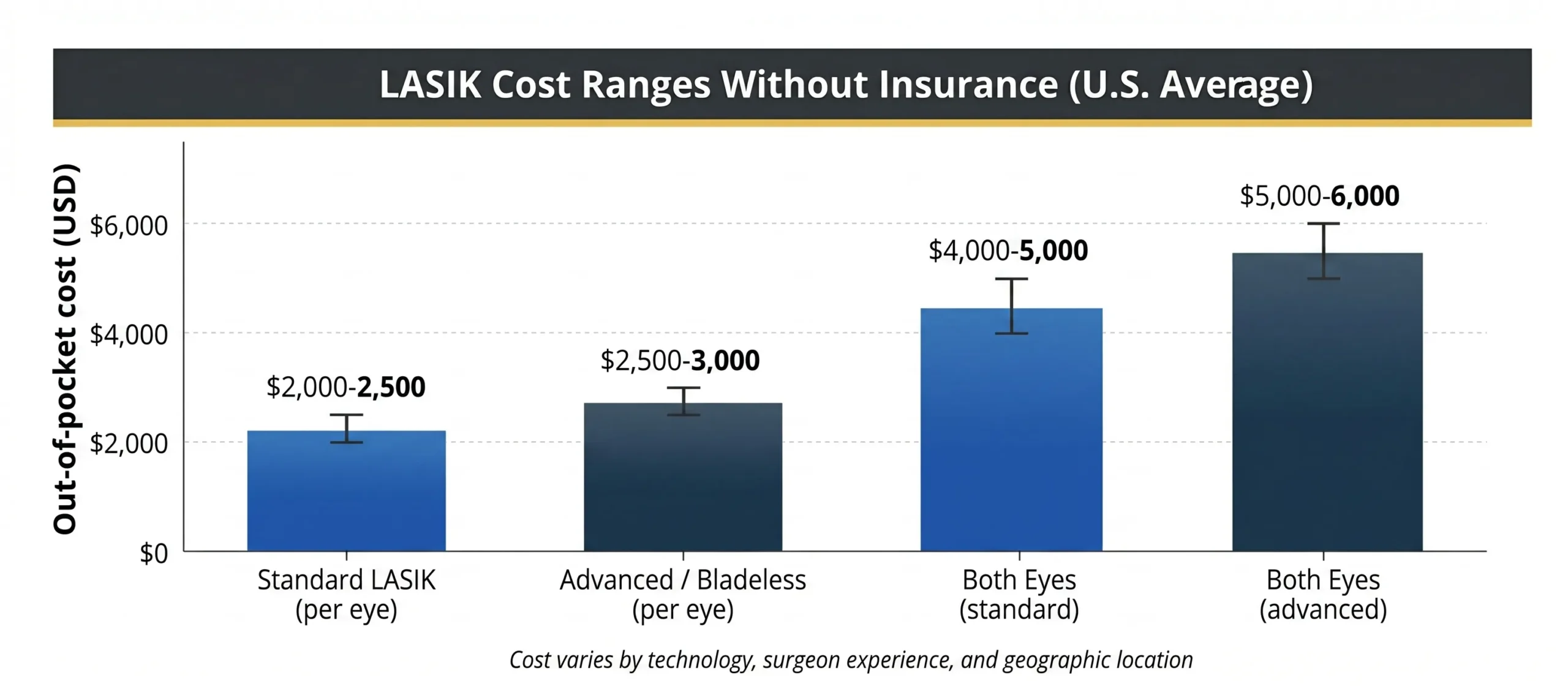
LASIK cost without insurance typically ranges from $2,000 to $3,000 per eye. At CCRS, LASIK in Los Angeles is $2,000 per eye, all-inclusive. Newer technologies like bladeless, wavefront-guided, and topography-guided LASIK tend to sit on the higher end of that range. Advanced equipment and precision increase overall costs but can meaningfully improve outcomes.
Factors that affect LASIK pricing
- Technology used – standard LASIK vs. topography-guided or ray-tracing advanced techniques
- Surgeon experience – years of practice, reputation, and procedure volume
- Geographic location – urban centers tend to cost more than rural clinics
- Package inclusions – follow-up visits, medications, enhancements
Additional costs to consider
- Follow-up visits – post-surgery assessments and monitoring
- Medications – prescription eye drops or other required treatments
Before committing to a provider, obtain multiple quotes and compare. Ensure each quote is comprehensive and includes any additional fees – the cheapest sticker price may not be the cheapest total cost.
The Exceptions
When Can LASIK Be Covered by Insurance?
While LASIK is generally elective, certain situations may warrant coverage. Insurance companies occasionally make exceptions for medically necessary cases. Here are the most common scenarios:
- Significant vision disparities between eyes (anisometropia) that cause substantial functional challenges
- Specific medical conditions such as aniridia or certain corneal diseases that severely affect vision
- Contact lens–related complications – chronic infections or severe allergies exacerbated by lenses may justify LASIK as a medically prudent choice
- Employer-sponsored health plans – some comprehensive benefits packages include LASIK perks
- Vision insurance network discounts – plans like VSP Vision Care provide reduced rates through their provider network
Coverage checklist – what to ask your insurer
- Confirm whether medically necessary vision correction procedures are covered under your plan
- Explore any partner discounts offered by your insurance
- Consult your employer’s HR department regarding LASIK-specific benefits
- Ask about pre-approval requirements and timelines
Who Offers What
Major Insurance Companies & Their LASIK Benefits
Navigating insurance for LASIK requires understanding your specific policy. While most plans classify LASIK as elective, several major companies offer coverage, discounts, or partner programs. Knowing which companies provide these benefits can save you meaningful money.
| Provider | Typical Offering | What to Know |
|---|---|---|
| Blue Cross Blue Shield | Discounts through preferred provider partnerships | Coverage varies significantly by state; contact your local BCBS office for specifics |
| VSP Vision Care | Network discounts on LASIK through vision plans | Dominant player for LASIK discounts – check their network for participating clinics |
| UnitedHealthcare | Negotiated pricing with LASIK surgeons | Discounts come through specific vision plans – details vary widely by policy |
| Aetna | LASIK discounts via preferred clinics | Focus on discount programs rather than full coverage |
| Employer Health Plans | LASIK perks via partnerships | Ask HR – many employers add LASIK benefits invisibly to comprehensive packages |
| Vision-Only Plans | Reduced rates with approved providers | Often a supplementary benefit; may require in-network surgeon to use discount |
Important: Each insurer’s policies differ across states and plan tiers. Always call your insurance provider directly, describe the specific procedure (LASIK, SMILE, or EVO ICL), and ask about pre-approval requirements, in-network surgeons, and any promotional discounts available in your region.
Blue Cross Blue Shield – How to Access LASIK Discounts
Blue Cross Blue Shield offers LASIK discounts through their vision programs. Direct coverage is limited, but partnership discounts can meaningfully reduce costs. Policies vary significantly between states, so local inquiry is essential.
- Contact your local Blue Cross Blue Shield office directly
- Ask specifically about LASIK discount programs and partnership details
- Verify which LASIK surgeons and facilities participate in the discount network
- Ask about promotional events that may offer additional savings
VSP, UnitedHealthcare & Aetna – Vision Plan Discounts
VSP Vision Care is a dominant player in offering LASIK discounts – their vision plans frequently include network discounts for members. UnitedHealthcare and Aetna similarly offer negotiated pricing with LASIK surgeons rather than full coverage. Each provider’s framework differs, so direct communication is key to understanding eligibility and savings.
Do Your Homework
How to Check If Your Insurance Covers LASIK
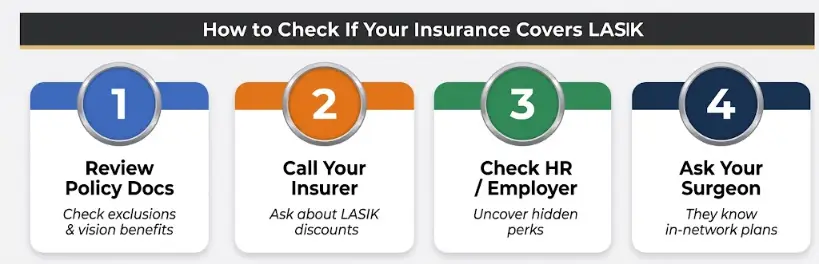
Determining your LASIK insurance coverage requires a few straightforward steps. Working through them in order ensures you don’t miss any available benefit:
1. Review your policy documents. Look for coverage details, exclusions, and any mention of vision benefits or partner discounts.
2. Contact your insurance provider directly. Speak with a representative, clarify coverage specifics, and ask if pre-approval is needed before surgery.
3. Check your employer / HR. Some employers offer LASIK benefits independently of the insurer – ask about any vision-specific perks or partnerships.
4. Consult your LASIK surgeon’s office. Experienced surgical offices know which local plans commonly provide discounts and can help you navigate pre-approval.
Questions to ask your insurer
- Coverage details: Is LASIK included in any form in my plan?
- Pre-approval requirements: What steps are needed for coverage or discounts?
- In-network surgeons: Which providers are part of your network?
- Discount percentage: What is the specific rate reduction?
- Benefit limits: Are there caps on LASIK benefits?
Pre-Tax Savings
Using FSAs, HSAs & Employer Benefits for LASIK
Flexible Spending Accounts (FSAs) and Health Savings Accounts (HSAs) allow you to pay for LASIK with pre-tax dollars. This can significantly reduce your effective cost by lowering your taxable income – a hidden-but-substantial form of savings.
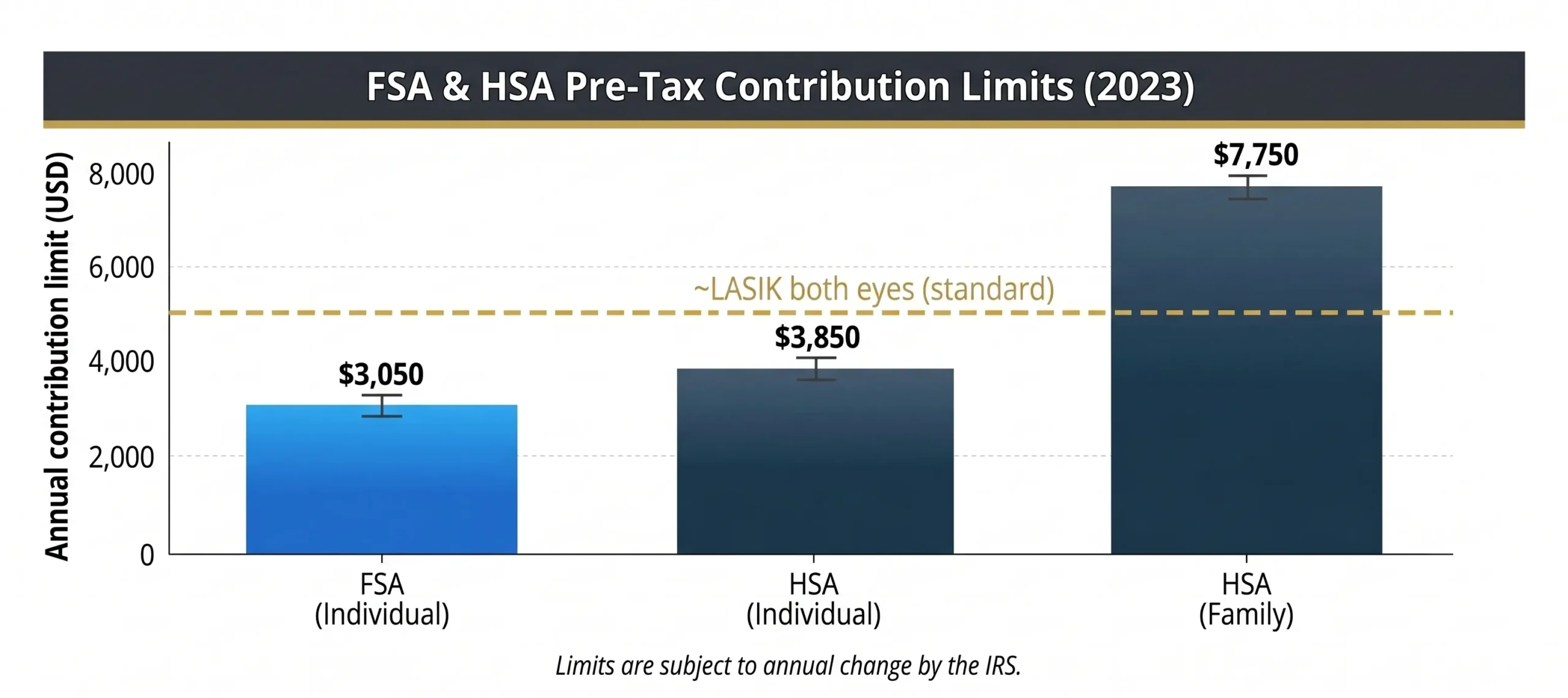
Both FSAs and HSAs allow contributions from your paycheck before taxes. The 2023 contribution limits are: $3,050 for FSAs, $3,850 for individual HSAs, and $7,750 for family HSAs. Consult your HR department for the current year’s limits, as these adjust annually.
Key benefits of using FSAs and HSAs
- Tax savings: Pre-tax contributions reduce your taxable income for the year
- Convenience: Access funds easily for eligible health-related expenses like LASIK
- Employer contributions: Some employers add funds to employee HSAs as a benefit
- Rollover (HSA): Unlike FSAs, HSA funds roll over year-to-year and stay with you
If your employer offers FSA or HSA, consider using it for LASIK. Check that your planned contribution covers the expected surgery cost to avoid unexpected shortfalls. Many patients time their LASIK to align with a plan year when they have maximum pre-tax funds available.
Payment Flexibility
Financing Options & Payment Plans
For many patients, financing provides the most direct path to affording LASIK. Several options can make the procedure accessible without needing full payment upfront.
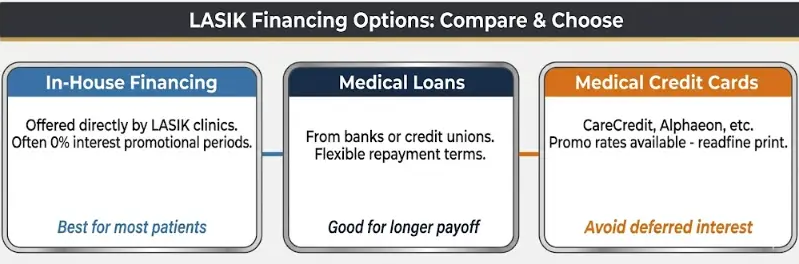
Many LASIK providers offer in-house financing with interest-free promotional periods. Personal medical loans from banks or credit unions offer flexible repayment terms – though interest rates vary. Medical credit cards (like CareCredit) offer convenience but regular interest rates can be high, so always read the fine print about deferred-interest provisions.
Some LASIK centers also collaborate with third-party financing companies that specialize in medical procedures. Patient satisfaction tends to be high when financing options are transparent and flexible – ask your provider’s office what’s available during your consultation.
Reduce Your Total Cost
Tips for Navigating LASIK Insurance & Reducing Costs
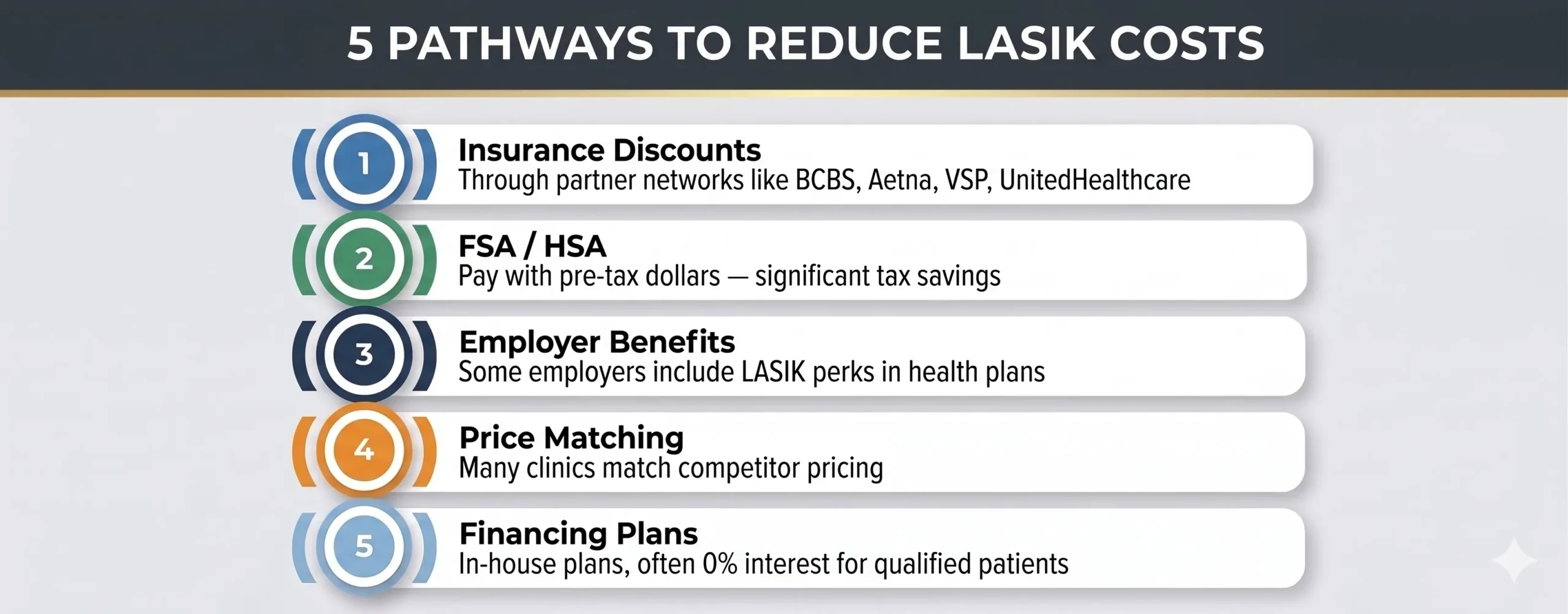
Navigating the world of LASIK insurance can be challenging, but a few strategies consistently lower total cost:
- Explore multiple insurance plans – compare what each offers for LASIK benefits or discounts
- Ask your employer about benefits – some employers provide LASIK discounts or partnerships invisibly
- Evaluate financing options – many LASIK providers offer interest-free payment plans
- Consider clinics with price matching – some providers will match a competitor’s verified written quote
- Use pre-tax accounts – FSAs and HSAs can produce meaningful tax savings on the full LASIK cost
- Build a relationship with your insurer – direct, open communication clarifies what’s actually possible
With vs. Without
Comparing LASIK Costs: With and Without Insurance
Understanding the cost difference between having insurance support and paying out-of-pocket is essential for planning. Here’s a side-by-side comparison:
| Without Insurance | With Insurance / Discount | |
|---|---|---|
| Per-Eye Cost | $2,000 – $3,000 | $1,500 – $2,500 (with typical discount) |
| Both Eyes | $4,000 – $6,000 | $3,000 – $5,000 (with typical discount) |
| Pre-Approval Needed? | No | Often yes for coverage; rarely for discounts |
| Paperwork | Minimal | Moderate (claims, submissions) |
| Pre-Tax Savings Eligible? | Yes (FSA/HSA) | Yes (FSA/HSA on remainder) |
| Typical Timeline | Quick (consult → surgery) | Add 1-2 weeks for pre-approval |
Discount ranges shown are representative. Actual savings depend on your specific insurer, plan tier, and the participating LASIK provider. Always request a written quote before scheduling surgery.
Common Questions
Frequently Asked Questions
Q: Does insurance cover LASIK eye surgery?
A: Generally, standard insurance policies don’t cover LASIK because it’s classified as an elective procedure. However, many insurers offer discounts through partner networks, and some vision plans include LASIK benefits.
Q: Are there circumstances when insurance does cover LASIK?
A: Yes. When LASIK is deemed medically necessary – for conditions like anisometropia, certain corneal diseases, or severe contact lens–related complications – some policies offer full or partial coverage.
Q: How do insurance discounts for LASIK work?
A: Certain insurers partner with specific LASIK providers who offer reduced rates to plan members. You typically need to use an in-network surgeon to access the discount.
Q: What is the average cost of LASIK without insurance?
A: LASIK typically costs $2,000–$3,000 per eye without insurance. Advanced techniques like topography-guided or ray-tracing LASIK fall on the higher end.
Q: Can I use an HSA or FSA for LASIK?
A: Yes. Both HSAs and FSAs can fund LASIK surgery. Because contributions are pre-tax, this is one of the most effective ways to reduce your effective cost.
Q: Do I need pre-approval from my insurer?
A: If your plan offers any form of LASIK coverage (not just a discount), pre-approval is usually required. Check with your provider for specific requirements.
Q: Are financing plans available for LASIK?
A: Yes – most LASIK providers offer in-house financing, often with 0% interest promotional periods for qualified patients. Third-party medical financing is also available.
Q: Should I consult my eye doctor about insurance?
A: Absolutely. Experienced LASIK surgical offices work with insurance plans daily and can guide you through discounts, pre-approvals, and financing in a single consultation.
Making the Decision
Making the Best Decision for Your Vision & Budget
Choosing to undergo LASIK is a significant decision involving both vision needs and financial considerations. Careful planning makes it manageable. Research your insurance options thoroughly, explore FSA/HSA pre-tax savings, and consult with experienced LASIK providers about pricing, technology, and payment options.
Ready to Explore Your LASIK Options?
Schedule a free consultation to discuss pricing, insurance benefits, FSA/HSA use, and flexible financing tailored to your budget.
CALIFORNIA CENTER FOR REFRACTIVE SURGERY
Los Angeles – San Fernando Valley – Pasadena – Rosemead
 Call
Call  Book
Book  Quiz
Quiz  Locations