

ArcScan Insight 100
Technology doesn’t replace surgical judgment — it sharpens it. Over more than 20 years and thousands of EVO ICL procedures, Dr. Paul C. Lee has learned exactly where the difference between a good result and an exceptional one lives: in the fraction of a millimeter of anatomy hidden behind the iris. That’s why CCRS invests in instruments like the ArcScan Insight 100.
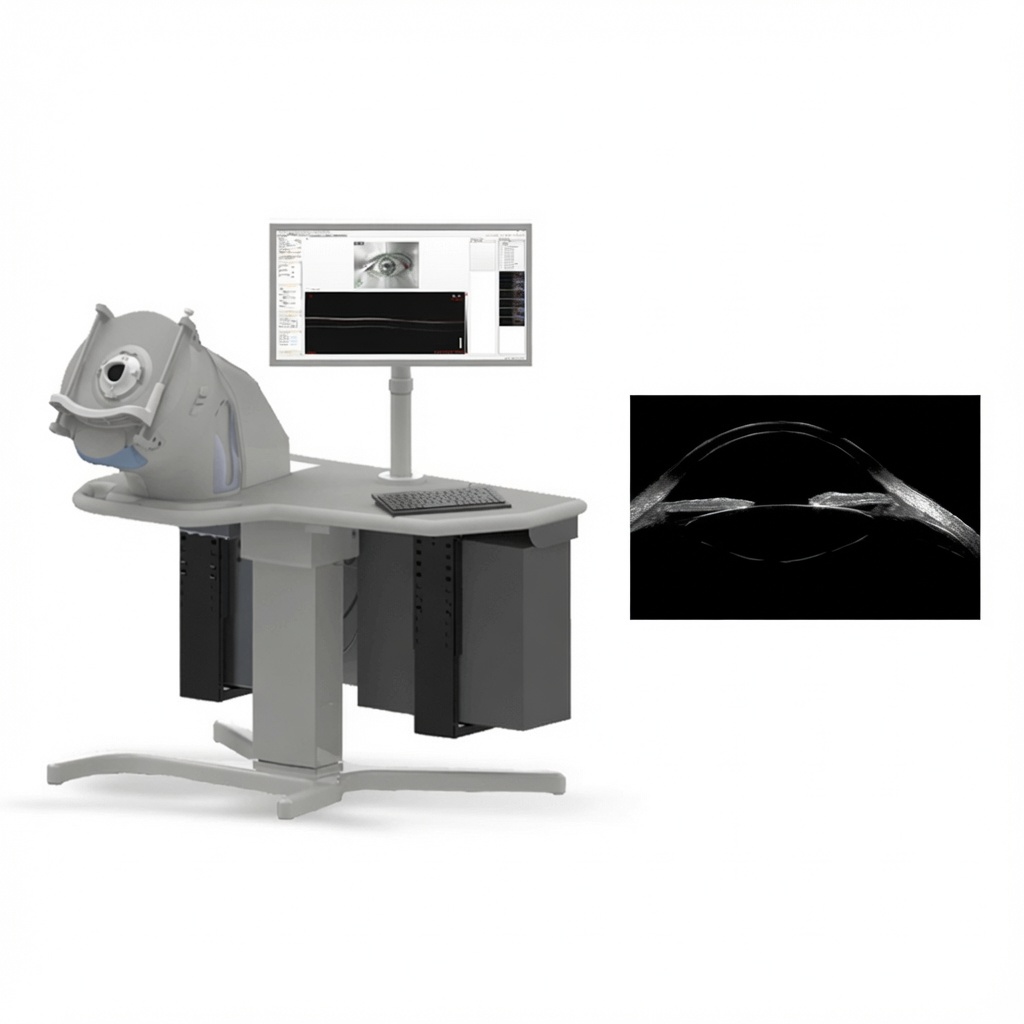
EVO ICL Sizing Technology
The ArcScan Insight 100: sizing your ICL by what's actually inside your eye.
A successful EVO ICL depends on one number most measurement tools can only guess at — the true size of the space behind your iris. The ArcScan measures it directly, so your lens is chosen from your anatomy, not an estimate.
Why Sizing Is Everything
With the EVO ICL, the lens size is the outcome.
The EVO ICL sits in the posterior chamber, just behind your iris and in front of your natural lens. The tiny gap between the two — called the vault — has to land in a narrow safe range. Choosing the right lens size is what puts it there. That single decision is where CCRS invests its most advanced imaging.
The vault is a window, not a target you hit twice
The ideal vault is roughly 250 to 750 microns — about half the thickness of your cornea at its narrowest. When the vault sits inside that window, the lens does its job invisibly and safely.
Outside it, the margins get thin. A vault that's too low can let the lens touch your natural lens; too high, and it can crowd the eye's drainage angle and raise pressure. The lens size chosen before surgery is what decides where you land.
Vault height between the EVO ICL and the natural lens. The dashed band is the target range CCRS sizes toward for every patient.
The Technology
What the ArcScan Insight 100 brings to your procedure
The ArcScan is a very-high-frequency ultrasound platform built for the anterior segment of the eye. Where optical scanners stop at the iris, ultrasound sees through it — giving your surgeon a direct look at the structures that determine ICL fit.
It sees behind the iris
Light can't pass through the iris, so optical devices estimate the hidden posterior chamber. Ultrasound passes right through, imaging the ciliary sulcus where the lens actually rests.
Micron-level resolution
A 50–60 MHz transducer sweeps in an arc that follows the eye's curve, resolving anatomy to about one micron. That precision is what direct sizing requires.
Repeatable, operator-friendly
The scan is standardized and highly repeatable, so the measurements feeding your lens choice aren't dependent on a single technician's hand.
Direct measurement, not estimation
Your lens is sized from the real internal dimensions of your eye — the ciliary body diameter and sulcus — instead of an external stand-in.
Comfortable and touch-free
Your eye rests against a soft, water-filled disposable cup while you look at a target. Nothing touches the surface of the eye, and the scan takes only minutes.
Rules out hidden surprises
The same scan can reveal cysts, masses, or anatomy that could affect candidacy — details that may not appear on standard imaging.
Direct Measurement vs. Estimation
Why "white-to-white" isn't enough for high-precision sizing
The most common shortcut for ICL sizing measures the visible width of the cornea — white to white — and estimates the internal size from it. Published studies show that estimate misses the true internal dimension in roughly one in four eyes. The ArcScan removes the guesswork.
⌀ White-to-White estimation
- Measures the outside of the cornea, then infers the hidden inside
- The visible cornea doesn't reliably predict the posterior chamber
- Inaccurate in about 25% of eyes, with errors that can exceed 0.5 mm
- Can't see cysts or anatomy behind the iris
◎ ArcScan direct measurement
- Images the actual posterior chamber and ciliary sulcus with ultrasound
- Sizes the lens from your real internal anatomy
- Feeds validated sulcus-based sizing formulas for tighter vault prediction
- Visualizes structures behind the iris that affect candidacy
Your Visit, Step by Step
How ArcScan sizing works at CCRS
Comfortable, touch-free scan
You rest your eye against a soft, water-filled disposable cup and look at a fixation light. The scanner sweeps in a gentle arc — no probe, no pressure, a few minutes per eye.
The posterior chamber is measured directly
The ArcScan captures the ciliary sulcus, the ciliary body inner diameter, and the surrounding anatomy at micron resolution — the exact measurements that predict vault.
Measurements run through a validated sizing formula
Your data feed a sulcus-based nomogram designed to predict where the vault will land for each available lens size — a far tighter prediction than white-to-white allows.
Dr. Lee selects your lens and plans placement
Dr. Paul C. Lee personally reviews the scan, chooses the lens size, and designs the placement for each eye — then confirms the plan with you before surgery.
The Evidence
Precision sizing is backed by published research
CCRS's approach isn't a marketing claim — it reflects the peer-reviewed literature on ICL sizing and the FDA safety record of the EVO platform.
In a published clinical series, very-high-frequency ultrasound sizing predicted the ICL vault to within 300 microns — about half a cornea's thickness — in 97% of eyes.
Ophthalmology Times, 2022White-to-white estimation fails to predict the true internal dimension in roughly a quarter of eyes, with errors that can exceed half a millimeter — enough to shift the vault out of range.
Peer-reviewed sizing literatureIn the 3-year FDA study of 629 eyes behind the current EVO age expansion, there were no cases of pupillary block or pigment dispersion, and a 0.16% cataract rate.
FDA clinical data, 2026Figures reflect published studies of very-high-frequency ultrasound ICL sizing and the EVO ICL FDA clinical trial. Individual results vary; your candidacy and expected outcome are determined at your consultation.
Surgeon-Led Care
Reviewed by Dr. Paul C. Lee, MD
"The technology matters because the lens size matters. Measuring the space behind the iris directly — instead of estimating it — is how we protect the vault and, with it, the long-term health of the eye. I review every scan and choose every lens myself."
Recognized among the West Coast's leading ICL surgeons, Dr. Lee has performed tens of thousands of vision-correction procedures across 25+ years. His EVO ICL patients include actor Jimmy O. Yang and Dr. Mania Asadourian, the first U.S. optometrist to receive the EVO ICL. Meet Dr. Lee →
Common Questions
ArcScan & EVO ICL sizing, answered
What is the ArcScan Insight 100?
It's a very-high-frequency ultrasound device that images the front of the eye at micron-level resolution. Unlike optical scanners, it sees behind the iris to directly measure the ciliary sulcus and posterior chamber — the space where an EVO ICL actually sits. CCRS uses it to size the lens by direct measurement rather than estimation.
Why does ICL sizing matter so much?
Sizing controls the vault — the gap between the implanted lens and your natural lens. The ideal vault is roughly 250 to 750 microns. Too low risks contact with the natural lens and cataract formation; too high can crowd the eye's drainage angle and raise pressure. Accurate sizing keeps the vault in the safe range.
How is ArcScan sizing different from white-to-white measurement?
White-to-white measures the visible cornea and estimates the hidden internal dimensions from it. Published data show that estimate is wrong in about a quarter of eyes. The ArcScan measures the posterior chamber directly with ultrasound, so the lens is chosen from your actual anatomy instead of an external proxy.
Is the scan uncomfortable?
No. You rest your eye against a soft, water-filled disposable cup and look at a target while the scanner sweeps in an arc. Nothing touches the surface of your eye. Each eye takes only a few minutes and the scan is painless.
Does every EVO ICL patient at CCRS get an ArcScan?
The ArcScan is part of the EVO ICL evaluation at CCRS. Your measurements are reviewed by Dr. Paul C. Lee, who personally selects the lens size and plans placement for each eye.
Who is a candidate for the EVO ICL?
The EVO ICL is FDA-approved for adults aged 21 to 60 to correct nearsightedness from -3.0 to -20.0 diopters, with or without astigmatism. It's often the best option for people with high prescriptions, thin corneas, or dry eyes who don't qualify for LASIK. A consultation with corneal imaging confirms candidacy.
How much does the EVO ICL cost, and is it covered by insurance?
Because the EVO ICL is elective, most medical insurance doesn't cover it, though FSA and HSA funds and financing are typically available. CCRS reviews all-inclusive pricing with you at your consultation. Request pricing →
Ready When You Are
See whether the EVO ICL is right for your eyes
Start with a free consultation at CCRS in Los Angeles, Sherman Oaks, or Pasadena — including the advanced imaging that makes precise ICL sizing possible, reviewed personally by Dr. Paul C. Lee.
Medical disclaimer: This page is for general education and is not medical advice. The EVO ICL is a prescription medical device; candidacy, sizing, and expected outcomes are determined only after an in-person examination. Research figures cited reflect published studies of very-high-frequency ultrasound ICL sizing and the EVO ICL FDA clinical program; individual results vary. Last reviewed July 2026 by Paul C. Lee, MD.
 Call
Call  Book
Book  Quiz
Quiz  Locations