
Cataract surgery · Los Angeles · Sherman Oaks · Pasadena
Fifteen minutes per eye, performed by Dr. Paul C. Lee in our in-office surgery suite. Standard lens implants are covered by Medicare and most insurance plans. If you want to rely less on glasses afterwards, premium and Light Adjustable lenses are available too.
A cataract is your eye’s natural lens slowly turning cloudy. It isn’t a film or a growth on the eye. The lens itself loses its clarity, usually from the mid-40s onwards, as proteins inside it clump together.
According to the National Eye Institute, more than half of all Americans aged 80 or older have had a cataract or cataract surgery. Because it happens gradually, most people adapt without noticing: they turn up the lights, avoid driving at night and keep updating their glasses. Glasses help for a while. Once the cloudiness gets in the way of daily life, surgery is the only treatment. The cloudy lens is removed and replaced with a clear artificial lens, called an intraocular lens or IOL.
There’s no need to wait until a cataract is “ripe.” The right time is when it starts to limit something you care about, like reading, driving at night or recognising faces across a room.
Not sure if it’s a cataract? A 2-minute vision assessment is a good first step, and a dilated eye exam at your consultation will confirm it.
The question we hear most. For the standard procedure, your insurance does most of the paying. What you add on top depends on the lens you choose.
| Item | Medicare & most insurance |
|---|---|
| Cataract surgery with a standard monofocal lens | Covered when medically necessary. With Medicare Part B, you pay 20% of the approved amount after your deductible |
| One pair of standard glasses or contacts after each surgery | Covered by Medicare Part B (20% after deductible) |
| Toric lens for astigmatism | Upgrade: you pay the difference |
| Extended depth of focus or trifocal lens | Upgrade: you pay the difference |
| Light Adjustable Lens and its light treatments | Upgrade: you pay the difference |
Every plan is different, so every cataract patient gets an individual quote. We tell you, in writing and before you decide anything, which part your insurance covers, what a lens upgrade would add, and the total you’d pay. There are no surprises on the day.
0% interest financing is available through CareCredit, and FSA and HSA pre-tax dollars are accepted.
If you’re over 45 and tired of reading glasses but don’t have a cataract, the same operation done earlier is refractive lens exchange. It’s elective, so insurance doesn’t usually cover it. At CCRS it starts at $7,000 for both eyes, all-inclusive.
This is the decision that shapes how you see for the rest of your life. There’s no single best lens, just the best one for how you use your eyes. A keen night driver and a keen reader shouldn’t necessarily get the same implant.
| Lens | What it gives you | Trade-off | Insurance |
|---|---|---|---|
| Standard monofocal | Sharp vision at one distance, usually far | Reading glasses usually needed | Covered |
| Toric (astigmatism-correcting) | Corrects astigmatism, which a standard lens leaves in place | Needs precise alignment, which our digital guidance handles | Upgrade |
| Extended depth of focus (EDOF) | A smooth range from distance to intermediate (dashboard, computer) | May still need readers for fine print | Upgrade |
| Trifocal | Distance, intermediate and near together | Higher chance of glare and halos at night | Upgrade |
| Light Adjustable Lens | Power fine-tuned with light treatments after your eye has healed, so you can preview and choose your vision | Several short follow-up light treatments | Upgrade |
| IC-8 Apthera small-aperture lens | Extended range of vision, including for some irregular corneas | Suits specific eyes; Dr. Lee will advise | Upgrade |
The Light Adjustable Lens is especially useful if you’ve had LASIK before, because lens-power calculations are harder after corneal surgery and the power can be fine-tuned afterwards. At your consultation, Dr. Lee uses iTrace ray-tracing analysis to show you how each lens is likely to perform in your eye before you choose.
With cataract surgery, the hard part isn’t removing the cataract. It’s choosing the exact lens power and placing the lens precisely. That’s where our technology comes in.
Swept-source optical measurement of your eye’s length and shape, the foundation of lens-power calculation.
Ray-tracing analysis of how light passes through your eye, used to measure how much the cataract is affecting your vision and to simulate lens options.
3D mapping of the cornea, essential for astigmatism planning and for eyes that have had LASIK.
Overlays your eye’s map in the surgical microscope in real time, so toric and premium lenses are aligned precisely without ink marks.
Measures your eye during surgery, after the cataract is removed, to confirm the lens power and astigmatism correction before the lens is set in place.
Remove the cataract with controlled ultrasound energy while keeping pressure inside the eye stable, which is gentler on the eye.
About 15 minutes per eye, done as an outpatient in our in-office surgery suite. One eye at a time, usually a couple of weeks apart.
Anesthetic drops numb your eye and you’re given an oral sedative. You’re awake, with no needles and no general anesthesia.
Dr. Lee makes an opening of about 2.5 mm at the edge of the cornea.
Ultrasound breaks up the cloudy lens and it’s gently removed. This is phacoemulsification, sometimes written as KPE on paperwork.
ORA confirms the lens power while you’re still in surgery.
The folded lens implant unfolds into place. The incision seals itself, with no stitches.
Most patients see clearer, brighter colours within a day or two. Many say “the sky has become bluer and the roses redder.”
Someone drives you home. Rest, and wear the protective shield while sleeping.
Check-up with Dr. Lee. Most people return to work and normal activities.
Prescription drops for several weeks. No swimming, strenuous exercise or eye rubbing for about two weeks.
Usually treated a couple of weeks after the first, once it has settled.
It’s one of the most frequently performed operations in the world, and one of the safest. Like any surgery it carries risks. The American Academy of Ophthalmology lists inflammation, infection, under- or over-correction and, rarely, retinal detachment. Some patients later notice a haze behind the implant (posterior capsule opacification). It’s fixed with a quick in-office laser treatment called YAG capsulotomy.
Because we offer every vision correction procedure under one roof, we recommend the one that fits your eye, not the one we happen to have a machine for.
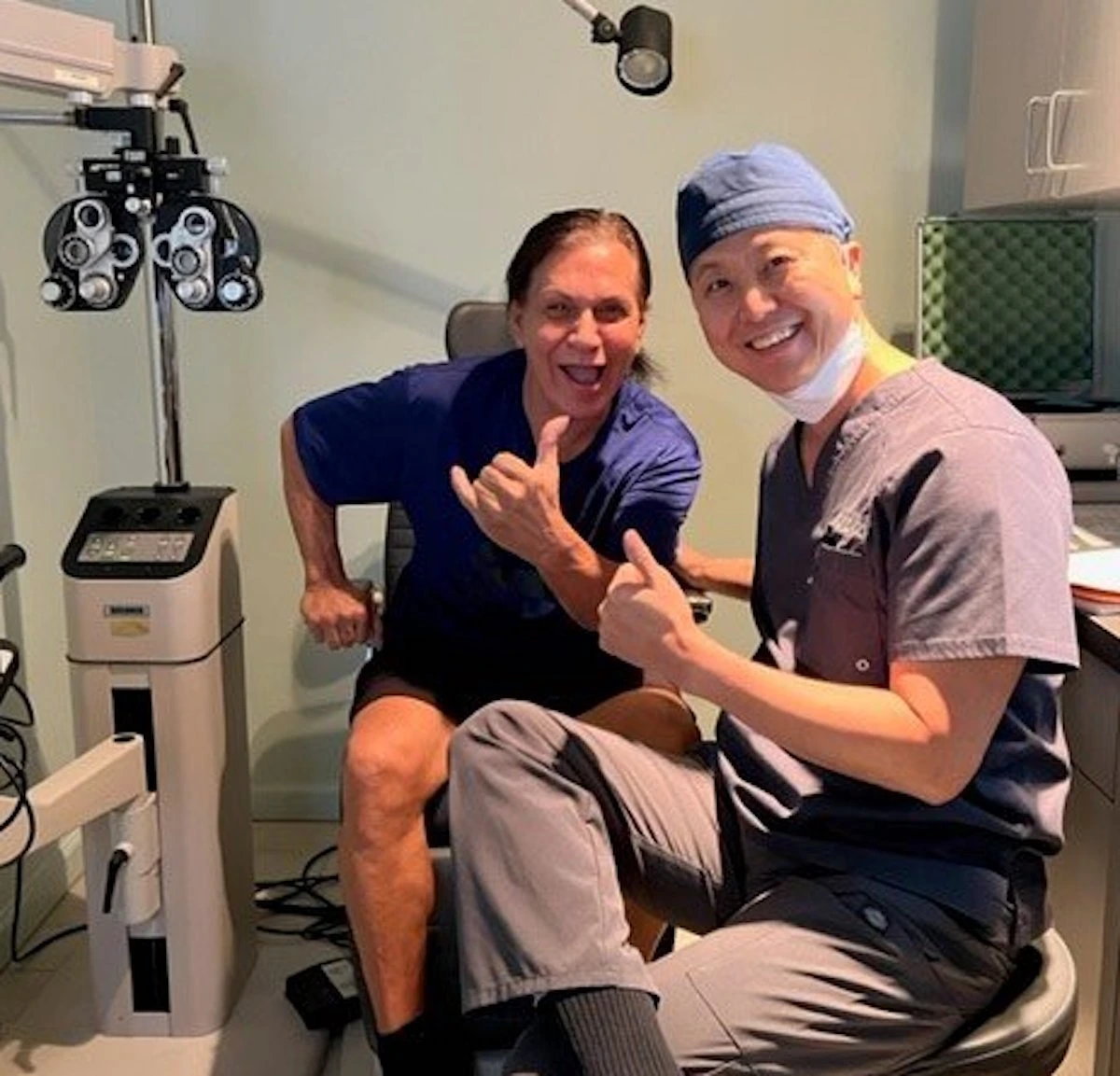
Dr. Paul C. Lee, MD is a board-certified ophthalmologist with more than 25 years of experience. He personally performs your exams and your surgery.
“He is definitely a world-class physician that I’m very grateful I found. My vision was really bad before the surgery. I’m amazed what a difference it made.”
Tony, cataract surgery patient
Monday to Friday, 8:00am–5:00pm. One phone number for all three: (323) 933-3111.
Coming from farther away, such as Orange County, Long Beach or the Inland Empire? Call us and we’ll help you choose the most convenient office and plan your visits.
Yes. Medicare Part B covers medically necessary cataract surgery with a standard (monofocal) lens implant. After the Part B deductible, you pay 20% of the Medicare-approved amount. Medicare also covers one pair of standard eyeglasses or one set of contact lenses after each cataract surgery that implants a lens. If you choose a premium lens to reduce your need for glasses, the upgrade is an out-of-pocket cost on top of the covered portion. We confirm exactly what you will pay, in writing, at your consultation.
With Medicare or private insurance, most patients pay their deductible and coinsurance for surgery with a standard lens. Premium lenses — toric, extended depth of focus, trifocal and the Light Adjustable Lens — add an out-of-pocket upgrade cost that depends on the lens. Because coverage varies by plan, CCRS quotes every cataract patient individually. If you have no cataract yet and want to stop needing glasses, refractive lens exchange at CCRS starts at $7,000 for both eyes.
Medicare covers a standard monofocal lens, which gives clear vision at one distance — usually far — so most people still use reading glasses. Astigmatism-correcting (toric) and presbyopia-correcting lenses are available as upgrades, with the extra cost paid by the patient.
The procedure itself takes about 15 minutes per eye. Plan on spending a few hours at the office on surgery day for preparation and a short rest afterwards.
You are awake but comfortable. Numbing drops are used instead of general anesthesia, and you are given an oral sedative to help you relax. Most people feel some pressure but no significant pain.
At CCRS each eye is treated separately, typically a couple of weeks apart, so the first eye can settle before the second is done.
Not on the day of surgery — you will need someone to drive you home. Most patients are cleared to drive after their next-day check, once Dr. Lee confirms your vision meets the legal standard for driving.
Most patients notice clearer, brighter vision within a day or two and return to work and most normal activities the next day. Vision keeps settling over a few weeks. You will use prescription eye drops for several weeks and avoid strenuous exercise, swimming and rubbing your eye for about two weeks.
That depends on the lens you choose. With a standard monofocal lens, reading glasses are usually needed. Extended depth of focus and trifocal lenses cover more of the range, and many patients go without glasses for most daily tasks. The Light Adjustable Lens can be fine-tuned after surgery to the vision you prefer.
No. Once the cloudy natural lens is replaced, the cataract cannot return. Some patients later develop a haze behind the implant called posterior capsule opacification, sometimes described as a secondary cataract. It is treated with a quick in-office laser procedure called YAG capsulotomy.
Yes. Choosing the lens power is more complex after LASIK, so bring any records of your LASIK surgery if you have them. The Light Adjustable Lens is especially useful here, because Dr. Lee can fine-tune the lens power after it has been implanted.
KPE stands for Kelman phacoemulsification — the medical name for modern ultrasound cataract surgery, named after its inventor, Dr. Charles Kelman. If your referral or insurance paperwork says KPE, it means cataract surgery.
Medically reviewed by Paul C. Lee, MD, board-certified ophthalmologist (American Board of Ophthalmology), cornea & refractive fellowship, Tulane University · last reviewed October 2026.
A full cataract evaluation with Dr. Lee, a clear explanation of your lens options, and a written breakdown of what your insurance covers and what you’d pay.
(323) 933-3111

 Call
Call  Book
Book  Quiz
Quiz  Locations